Free 2 Day Shipping With Amazon Prime

Showing posts with label Money. Show all posts

Wednesday, November 10, 2021

Secret Sauce


Man's Life Stages

Making the most of life is always important but never as important as when you near your Golden Years.  I refer to this post as Man's Life Stages only because it's being shared by me and obviously a man's perspective.  Having said that, all I share will also apply to a person of the opposite gender.  


Three Measures

For the purpose of this post, I will use three measures on every Stage of Life, and they are: Time, Money, and Energy.

  • First Stage - Youth: Many young men during their high school years and some even into college have plenty of time and energy but minimal money.  
  1. Without a doubt, most often by choice or circumstance.  Their values and priorities have yet to be developed.  I on the other hand had my very first successful business at the age of 10.  Some might say I was lucky, however, Luck is what happens when preparation meets opportunity.  
  2. I'm sure that multitasking has been around for a long time, I can't remember a time when I didn't have at least 3 or 4 things going on at the same time.  I would even go as far as to say that the common problem is lacking motivation, and thus lacking money.
  • Second Stage - Adult: Young adults by now for the most part have completed college or entered the work force, started a business and/or are working their way up the corporate ladder. Some maybe even have gotten married and are raising a family.  All of a sudden they find themselves (hopefully) with plenty of money, and energy (still young) but no time. 
  1. It doesn't have to be as describes but I'll guess that a sampling would show approximately 90% as described.
  2. This stage of life is a time when many relationships get stressed to the breaking point.  If you don't have a strategy and great partner to help you through it, you may run into some tough challenges.  Managing your limited time is crucial.  My wife and I had 4 children, and I was fortunate that she wanted to be a stay at home mom until all the children were attending school full time. In the meantime she was involved in our family business which didn't impose a stringent work schedule on her. 
  • Third Stage - Old: If you worked smart and diligently had some good luck, and kept all the chainsaws you were juggling up in the air, you should find yourself with lots of time, ample money, but low on energy.
  1. Hopefully you made your money for retirement and made some wise investment choices before you ran low on energy.  I've always said that in life I took some risks based on knowing that if I failed I had enough time to recover the losses.
  2. However, at some point in my age progressions I started playing it safe.


And now for the Secret Sauce:  There is one element that can make all the difference in the world at every one of the 3 stages especially the third one.  I'm sure we have all heard someone say, "if only I had known I was going to live this long, I would have taken better care of myself."  We don't all have the blessings of good genes, or healthy habits plus a great life partner who keeps us on the straight and narrow to better life choices.

If you already missed the train to good health in your golden years, then you must share this and other similar articles with your children so they don't end up finding out at a later time in life.  As always, I make the claim that I am healthy, happy and blessed.  I still have enough energy to be working, even if I really don't have to (because I am retired).  I still enjoy long road trips in which I do all the driving by choice.  I have many interests and I stay mobile and involved.  Remember: If you don't get of the couch while you can, you won't be able to get off when you have to.  The best is yet to come.....

Thursday, May 26, 2016

Hit The Road Jack

Road Trip Time

If you have plans to travel over the holiday weekend, be prepared to pay higher prices for a gallon of fuel if you travel to or through high traffic and popular areas.  The price for a barrel of oil just went over the $50 dollar per barrel mark since February 2016 when it was $26.
Whenever I go on a road trip I google the location of all the Costco gasoline station along my route.  They are not always as convenient as I wish they were, but I’ve been known to go a few miles out of my way to fill up at as much as 30 to 70 cents cheaper per gallon.
Looking at the Los Angeles area for this holiday weekend the Costco gasoline stations range from $2.32 per gallon on the low end to $2.42 on the high end.  By comparison the in the same area (LA) Super 8 in Norwalk from $2.37 to $4.29 at a Chevron on N. Alameda and N. Main St.

If you take a chance it will just come down to where you get low on fuel, and feel that you can no longer risk it and go for the best price you can get at a gas station.  On the other hand, if cost is no object, simply enjoy your trip and know that this holiday’s gasoline prices are amongst the best (lowest) we’ve seen for a while.


Many experts are predicting record number of travelers due to the great gasoline prices and the fact that we just came out of a long winter, and need the family getaway.  Expect heavy and slow traffic at times, and long lines almost everywhere you go.  Safe and happy motoring.  Remember the new laws regarding use of restrooms, keep your family safe.  The best is yet to come…………..

Monday, December 21, 2015

Decreasing Value

Decreasing Value

Another great title for this post could be Disappearing Middle Class.  For some of us that have had a wonderful run in the workforce, and are now retired.  If we prepared adequately (education or training) and either saved money or invested wisely, and had a big helping of good luck.  By good luck I mean not have 80 to 100% of your investments in the stock market around the time of the market collapsed.  For those of us; we are surviving with our heads above water where the finances are concerned.  We don’t even notice our declining finances because we have been adjusting our extracurricular activities.  Examples:  Stop taking the annual vacation to fancy resorts in or out of the country, dropped the Golf Membership at the Country Club, stopped driving the expensive SUV (gas guzzler) and moved into a more economical sedan, Cut down eating out from twice weekly to twice monthly (entertaining more at home), etc., etc.

When my wife and I first got married and even now we like to guess how much our groceries are going to cost while the cashier is processing our groceries.  We like to see how sharp we are at guessing and see who comes the closest to the total cost.  The only prize is the honor of guessing the closest and show off our mathematical genius.  It used to be that a rule of thumb was on average $10 per bag of groceries.

Like everything else the prices have gone up and the size of the bags have gotten smaller.  Coincidence, I don’t think so.  Just like the size of a candy bar got smaller and the price stayed the same for about a year and then they totally lost their shame and raised the prices anyway (have you noticed that the size of a case of pop is now 20 cans instead of 24, yet the price stayed the same or went up).  Earlier this week I was sent out on a grocery run and as often happens, I was in the mood for reflection.  As has been typical since the drought broke in the Northwest, it was a rainy evening.  

After rushing into my car to avoid getting soaked, I noticed that I only carried out two small bags of groceries, and a couple of lose items that were too heavy for the flimsy paper bags with handles that they now sell you for five cents each.  The paper handles on the bags break long before you get home.  Total paid for the few items I purchased was over $50.  That is an average of 25 dollars per bag.  The few items that I carried unbagged were a gallon of milk, ½ gallon of orange juice, and a two liter bottle of pop.

It wasn’t that long ago that I remember buying a five pound sleeve of ground beef for $4.39 today in some stores that’s the price per pound, even more if you buy the 93% fat free.  Today’s price of the cheapest cut of beef (Chuck Roast) is $6.99 per pound.  That used to be the price of Top Sirloin.  The saddest thing is that, the market place ratchets the screws on our budgets so much and so high that when they finally have a sale to draw you into the store, and we are so grateful and reward them with our budget dollars.

I remember that growing up my parents used to look at the weekly sales (printed on paper flyers) and would actually shop the different stores to buy the advertised sales leaders.  I do believe I see those day coming back.  The reason for the high prices is often blamed on the cost of oil (transportation), the drought (lack of irrigation water for agriculture), Global Warming (according to politicians, what happens in Timbuktu affects Cucamonga, California, etc., etc.). 


There will have to be at least two more posts on the subject of what’s making the Middle Class disappear.  I don’t care about all the excuses (reasons) I hear; the number one reason for the high prices is greed and crooked corporations (they raise prices because they can – 200% plus increase in CEO compensation over the last 2 or 3 years).  We can return our country (world) to greatness, but we need to get involved or at least be aware.  The best is yet to come…….

Tuesday, October 6, 2015

Your Money’s Worth

Is it even copper anymore?

It used to be acceptable and almost a compliment to have someone say to you, “A penny for your thoughts?”  Of course that was back when you could buy something for a penny.  While it wasn’t much of a value, it was more value than it is today.  I used to frequently go to a store and if the total of my bill was say $9.56, I would regularly pay with a ten dollar bill and say keep the change and walk away.

That was my way of keeping change out of my pockets that were of questionable value and mostly served to wear out my pockets.  That was my habit, until one day when I ran into the cashier from hell that change me forever.  I was six cents short for the purchase I was making, and I wasn’t allowed to take the product.  Since that time, I must have filled about four - five gallon clear plastic refill drinking water bottles (the kind that you place inverted on your water cooler).  The copper coins go to good use, I allow my granddaughters to share my treasure.

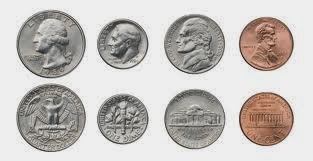
The following is a little lesson about our U.S. Mint and the coins we mostly take for granted, especially with the use of the debit card.

·       The U.S. Mint cut the cost of making the penny by nearly a third over the past two years, but the little copper-coated coin still costs more than a cent to produce.  A new report shows the cost to produce a penny was 1.7 cents in the 2014 fiscal year. That’s down from 2.4 cents in 2011 but still more than face value.  “There are no alternative metal compositions that reduce the manufacturing unit cost of the penny below its face value,” the biennial report to Congress said.
·       The nickel, too, is dead weight for taxpayers. Production costs stood at 8 cents last year, down from 11 cents. The lower cost per coin is largely a result of rising production and reduced metal costs.
·       Other coins turn a profit. A dime costs 3.9 cents to make, and a quarter 9 cents. All together, the Mint made $289.1 million on seigniorage–the difference between the value of the coin and the cost to make it–despite a $90.5 million drag from the penny and nickel.
·       The Mint estimates that switching up the metallic content of coins could save taxpayers $5 million to $57 million a year, though vending, amusement, laundry and other groups with coin operated machines warn that it could cost them billions to reconfigure machinery and make other adjustments needed to accept altered specie, the Mint said. ~ Wall Street Journal – By JEFFREY SPARSHOTT

I realize that what I am about to relate will sound a bit like science fiction, but once upon a time not all that long ago, you could buy a gallon of gasoline by simply putting together 13 of those little copper coins.  You could also buy a McDonald’s Hamburger for 12 pennies, or a Taco Bell crunchy taco for 11 pennies even a 12 ounce pop for 5 pennies.  You could run up a hefty dental bill by over indulging on penny candy.  In the State of Texas you could buy a Texas famous sweet and juicy orange for a penny a piece.  That’s right one hundred for a dollar.  I could go on forever with the value that a penny could add to your life back then.  The best is yet to come…………..

Saturday, May 2, 2015

The Fight of the Century

The Fight of the Century
As usual this is one man’s humble opinion, if you don’t agree, I am perfectly fine with it.
·       In 1971, both Ali and Frazier had legitimate claims to the title of World Heavyweight Champion. An undefeated Ali had won the title from Sonny Liston in Miami Beach in 1964, and successfully defended his belt up until he had it stripped by boxing authorities for refusing induction into the armed forces in 1967. In Ali's absence, the undefeated Frazier garnered two championship belts through devastating knockouts of Buster Mathis and Jimmy Ellis. He was recognized by boxing authorities as the World Champion. Unlike Mathis and Ellis, Frazier was plausibly Ali's superior, which created a tremendous amount of hype and anticipation for a match pitting the two undefeated fighters against one another to decide who was the true heavyweight champ.
·       Ringside seats were $150, each man was guaranteed 2.5 million dollars, in addition to the millions who watched this amazing hour of sporting history unfold on closed-circuit screens around the world the Garden buzzed with a sell-out crowd of 20,455 that provided a gate of 1.5 million dollars. ~Wikipedia
Mayweather vs Paquio
Today once again the Fight of the Century is being hyped and this time the fight is serious money for all involved including the consumers and sports fans (in some instances one and the same).  For the consumer the just to stay home and watch it on pay per view $99.99 on your local cable service.  Anyone traveling to Las Vegas to be close to the action I hear that hotel rooms that normally go for $200 dollars this weekend they are going for $1600 dollars according to reports earlier in the week.  That is 10 times higher than ringside seats went for during the fight of the century in 1971.  At last report earlier this week the going price for the cheapest ticket at the live event was $16,000.00 online.

I am not complaining because I am not in position to spend that kind of money on any kind of sporting event, but if I was, I’m sure that I could find a better way to spend my millions.
We are talking about two individuals that are going to knock each other’s brains out for all of maybe one hour, and each stands to make over 100 million for their participation.

I hate to think that there are people around the world whose life might be on the line because they don’t have the funds (20 or 30 thousand) to spend on a medical procedure that would save their lives, and our society very much like in the time of the Romans are gathering at the coliseum to watch two gladiators fight to near death (possibly). I like sports as much as the next guy or gal, but we are being scammed big time.


The best is yet to come….

Thursday, March 13, 2014

Wake Up Time

Before It's Too Late
Are we becoming passive in our older years?  I am referring to what’s going on in the world around us, and the fact that the majority of the population is just watching it go by.  Have you noticed that every time the government regulates or deregulates an industry (example: telephone service Ma Bell) we are sold on it as being better for us or saving us money.  Yet without exception the cost associated with that industry goes sky high in price.
I know that there has been a lot of progress made in all the industries in our country and the world for that matter.  My question however, begs an answer, do we all need to pay for the same level of service?  Many senior citizens don’t need 400 or 600 channels on cable.  I consider myself “with it,” and I have maybe 7 favorite channels that I always go to.  It would be nice if we could pay for only the channels we want to watch (a la carte).  The cable providers prefer to sell you bundles that include channels that no one would buy otherwise.
Back in the early 90s my cable bill was $7.95 per month I had more channels than I could view.  Today my cable bill is more than 30 times higher, but it does include internet, and landline (phone service) which I can do without, and a couple of DVRs.  In the old days we used to buy our own VCR.  Here is another irritating fact.  You can go to the Red Box video rental and rent a movie (DVD) for 24 hours for just $1.29.  But if you go to your cable provider and rent pay per view movie (streaming) no DVD involved, you pay between $5.99 and $9.99 what is wrong with this picture?  Of course as usual we can control the market by making our own informed decisions, and opt out.
It would be nice if we could come together to influence the market.  I once again opt out of things that are not a necessity in my life.  As an example because of changes in the airline industry, I travel a very small percentage of what I used to travel prior to 2001, and beside the challenges of security screening here is why:
·       Airline passengers now arrive at the airport prepared to be nickeled and dimed all the way to their destination by add-on fees — a moneymaking tool no longer used only by low-cost carriers but by nearly every type of airline, a new study reveals.
·       Total airline revenue generated by these extra fees, called ancillary fees, skyrocketed from $2.45 billion in 2007 to $27.1 billion in 2012. United Airlines topped the list of total ancillary-revenue leaders, generating more than $5.3 billion in fees last year. ~ By Kristen Leigh Painter-The Denver Post
I remember a time when the consumers would unite and boycott a business or product, and reverse a decision or action that was made against the consumer.  Today we lack resolve and cohesiveness, at a time when communications are so much improved, and yet it is being used against us.  This statement applies to: government, politics, social media, consumerism, education, etc., etc.  We are losing ground at all levels and on all fronts.  I believe it’s time to take our society and lives back, before we reach the point of no return.  The best is yet to come…….

Tuesday, March 4, 2014

Changing Life Rules

Future Island Paradise
 
I was recently talking to a friend about how I no longer bend down to pick up a penny on the sidewalk, because it takes so many of them to buy anything worthwhile.  Back when I was a very young man (during the mid to late 50’s) I remember buying penny candy and five cent soda.  Today in my State of residence it takes almost ten of them just to pay the sales tax on a dollar’s purchase.  A 20 ounce soda sells for $1.89 plus sales tax of about seventeen cents.  I can say to the government like they use to say on the Virginia Slims cigarette commercials, “you’ve come a long way baby!”  Back when soda was five cents they didn’t even have Sales Tax, and with today’s Sales Tax I could buy 3 sodas at old time prices and two pieces of penny Bubble Gum.
 
I keep a special decorative jar in the master bedroom where I empty all my change (coins) at the end of a day.  They are a hassle to carry around, plus they wear your packets prematurely, and no, I am not going to carry around a coin purse.  That’s what my grandfather use to carry, but there again coins were worth something back then.
 
Up until about 5 years ago, I used to tell cashiers to keep the change when we were talking about a dime or less in change. Then I realized that if I was short a dime or less at point of sale I would be made to return the item for lack of money.  The coins I save find their way into parking meters or the like.
 
Another rule change in my life: I feel that I’ve reached a point in my life where the odds of me winning the Lotto have improved.  All you have to do is look at the Lotto history of winners.  Nine out of ten winners are around my age and retired.  I do, however, only play the very big jackpots.  I wouldn’t want to win a million dollars and know that I will never win another jackpot because the odds of that happening are not favorable.  I know that one of these days I will post that I have won the lottery and will be retiring from the blog because the island I am buying doesn’t have internet service.
 
Here is some more information to back me up on my rule on the use of coins:
·       WASHINGTON (Reuters) - In a budget proposal that aims to make government more efficient, President Barack Obama on Tuesday floated the idea of using alternative metals to make penny and nickel coins.
·       The fiscal 2015 budget, released on Tuesday, points out that the coins' manufacturing and circulation have not changed in decades and that the Treasury Department has been reviewing the coins' production. Obama has proposed similar reviews in the past but the measures stalled despite not being partisan points of contention.
·       Obama's 2014 budget had pegged the cost of manufacturing a penny at two cents and the price of a nickel at 11 cents. ~ (This version of the story was corrected to make clear that Treasury is not considering phasing out penny or nickel coins, is looking instead at using alternative metals) (Additional reporting by Patrick Temple-West and Emily Stephenson; Editing by Bill Trott)
 
The best is yet to come…..

Tuesday, February 25, 2014

The Bottom Line

The Bottom Line
Have you ever felt like OSHA will have to require that handles be installed if more people are to climb on your back?

·      OSHA's Mission:                                                                                                                          With the Occupational Safety and Health Act of 1970, Congress created the Occupational Safety and Health Administration (OSHA)* to assure safe and healthful working conditions for working men and women by setting and enforcing standards.

Every time we turn around some large corporation, government agency or small business, is trying to somehow get more money out your pocket or bank account.  Most people don’t realize the amount of taxes per gallon of gasoline they pay in their respective States.  In the State of Washington the tax on a gallon of gasoline is just under 50 cents per gallon.  Do you realize that for every 30 gallons of gasoline you buy you are paying $15 dollars out of pocket before you even get a drop of gasoline in your tank?
 Washington: Cents per gallon 37.5 other taxes .096 includes HASMAT fee and Oil Spill Admin Fee
Today I was hungry and decided to stop at a place where I’ve stopped a few times in recent years and was surprised that they wanted an extra 40 cents for using a credit card.  The total was under $4 dollars so the surcharge amounted to more than 10%.  I mentioned to the cashier that it was a bad move on the owner’s part because he would lose business.  Her answer was it’s not his idea it’s the banks.  I explained that I am also a businessman that the cost is more like 1.5% per transaction.  I don’t know about the rest of his customers but I for one don’t plan to go back even if I have cash in my pocket.
What the owner should have done is add 5 or even 10% to all his menu items, and not mess with the transaction.  I doubt that anyone would notice the increase on such small prices. I don’t feel that I am being petty, because I probably do 10 to 20 transactions per day, and if everyone decides to add 40 cents per transaction that adds up to 8 dollars a day.  I enjoy dealing through my church for charity’s sake, but then again every time I go to pay for anything at a cashier stand everyone wants a dollar for one charity or another.

The following information shouldn’t surprise anyone, but then again it might:  How Much Does the Average Person Pay in Taxes?
  • Answer: The amount the average person pays in taxes is between 40% and 54.4% of income. The variance is due to where they live and income levels. Each state and even municipalities have their own sales taxes and various usage taxes which must be figured into the total. On top of the self-employed people pay the entire amount of Social Security as opposed to employees whose employers pay half. The overall tax picture requires that people consider the fuel taxes and other taxes when determining their average tax amount.  ~ Reference: www.cato.org
Imagine the disappointment of realizing that whatever wage you earn you only keep around 50% or less.  All of a sudden 40 cents per transaction, and a dollar for charity every time you go through a cash register adds up.  I don’t start my day by wanting to be a cheapskate, but aren’t taxes supposed to go in part to help the less fortunate?  The best is yet to come…..

Friday, February 21, 2014

Overnight Success

Very Early Beatles
How many times have we heard of something or someone on the national or world spotlight for the first time, and assume it was overnight success?
Here is the perfect example of the road to overnight success:
Before They Were Beatles: 1957-1959
  • John Lennon was just 17 when he formed his first band, The Black Jacks. The band was made up entirely of classmates at Quarry Bank Grammar School in Liverpool, and almost immediately after they started, they changed their name to The Quarry Men. They played skiffle music, a mixture of folk, jazz, and blues which was popular in England at the time.
  • In the summer of 1957, The Quarry Men were setting up for a performance in a church hall when another member of the band introduced Lennon to Paul McCartney, then a 15-year-old self-taught left-handed guitar player. He auditioned for the band when they finished their set, and was immediately invited to join, which he did in October, 1957.
  • By February 1958 Lennon was moving increasingly away from skiffle and toward rock 'n' roll. This prompted the band's banjo player to leave, giving McCartney the opportunity to introduce Lennon to his friend and former classmate, George Harrison.
  • The band, which then consisted of Lennon, McCartney, Harrison, piano player Duff Lowe and drummer Colin Hanton recorded a demo consisting of Buddy Holly's "That'll Be the Day" and a Lennon-McCartney original, "In Spite of All the Danger."
  • The Quarry Men broke up early in 1959. Lennon and McCartney continued their songwriting, and Harrison joined a group called The Les Stewart Quartet. The Quarry Men briefly reunited when Harrison's group fell apart, and he recruited Lennon and McCartney to help him fulfill a contract with Liverpool's Casbah Coffee Club. When that gig ended, Lennon, McCartney and Harrison continued performing as Johnny and the Moondogs. ~ Wikimedia
 
Now for another example of overnight success:
Catalog Stores (mail Order):  Many of us remember becoming aware of catalog sales in the 1950’s and 60’s when some of our mothers would order our back to school clothes through Sears or Wards Catalogs.
  • The heyday of the mail-order business occurred between the 1890s and the 1910s, when it was dominated by Montgomery Ward and Sears. During this period, these companies became two of the largest business enterprises in the United States. Wards, which opened several mail-order branches across the country during the first part of the twentieth century, was employing over seven thousand men and women in the Chicago area by 1910. By 1913, Wards was selling about $40 million worth of goods per year.
  • Even more astounding than the rapid growth of Wards was the rise of Sears. The firm of Sears, Roebuck & Co., which settled in Chicago in 1895, was the creation of a Minnesotan named Richard W. Sears. After getting his start in the 1880s by selling watches through the mail, Sears (whose partner Alvah C. Roebuck started as a watch repairman) established a general mail-order company along the lines of Wards. Only a few years after its birth, Sears overtook Wards as the leading mail-order company.
  • Like Wards, Sears issued giant catalogs and succeeded in attracting orders for a variety of goods from hundreds of thousands of rural consumers. By 1905, Sears had about nine thousand employees, and its annual sales approached $50 million. Much of Sears's success was overseen by Julius Rosenwald, who became a partner in the company in 1895 and became its president after Richard Sears retired in 1909. By 1914, when Sears had branches in Dallas and Seattle in addition to its central operation in Chicago, the company's annual mail-order sales had surpassed $100 million. ~ Wikimedia
 
Always remember that just because you become an overnight success it doesn’t mean that you will be around forever.  The arrival of Amazon.com was the end or decline of catalog sales as we knew it.
  • Jeff Bezos incorporated the company (as Cadabra) in July 1994 and the site went online as Amazon.com in 1995. The company was renamed after the Amazon River, one of the largest rivers in the world, which in turn was named after the Amazons, the legendary nation of female warriors in Greek mythology. ~ Wikimedia
As always the best is yet to come……

Wednesday, February 19, 2014

Shopping History

Shopping History
Intelligent businessmen have been trying to get to our money for as long as money has been around.  Shoppers have willingly parted with their money in ever faster ways.  Today we don’t even have to leave our homes to buy products on line and we trust total strangers with our credit card information somewhere and everywhere around the world.
I still remember times in the past when we operated with the premise of cash on delivery (C.O.D.).  C.O.D. was the ultimate guarantee that you could trust the company or individual you were dealing with.  The Company or individual was so sure of his product and integrity that he was willing to deal on a C.O.D. basis.  Imagine this, the seller was incurring the shipping cost, risking that you may not accept and pay for the shipped product.  In today’s world the buyer (customer) assumes all the risks.
When I talk of shopping history I am only making reference to the period that covers our particular time of existence (perhaps our parent’s existence-late 50s to present day).  During this period of time I experienced many efforts to change the shopping experience:  from door to door sales to Pyramid, and including the arrival of large department stores.
 
Almost forever large department stores have had a bargain basement section.  The bargain basement is where you found bargains at clearance prices.  This bargain items were always typically the end of a season clothing, the last of a product line where as an example there may only be one or two select sizes left, or even a discontinued line of a product.
Here are some histories of your most common shopping experiences:
Amway (short for American Way)
  • Is an American company using multi-level marketing techniques that sells a variety of products, primarily in the health, beauty, and home care markets. Amway was founded in 1959 by Jay Van Andel and Richard DeVos. Based in Ada, Michigan, the company and family of companies under Alticor reported sales of USD$11.3 billion for the year ended December 31, 2012—the seventh consecutive year of growth for the company. Its product lines include home care products, personal care products, jewelry, electronics, Nutrilite dietary supplements, water purifiers, air purifiers, insurance and cosmetics. ~ Wikimedia
Discount Stores:
  • During the period from the 1950s to the late 1980s, discount stores were more popular than the average supermarket or department store in the United States. There were hundreds of discount stores in operation, with their most successful period occurring during the mid-1960s in the U.S. with discount store chains such as Kmart, Ames, E. J. Korvette, Fisher's Big Wheel, Zayre, Bradlees, Caldor, Jamesway Howard Brothers Discount Stores, Kuhn's-Big K (sold to Walmart in 1981), TG&Y and Woolco (closed in 1983, part sold to Wal-Mart) among others.
  • Walmart, Kmart, and Target all opened their first locations in 1962. Other retail companies branched out into the discount store business around that time as adjuncts to their older store concepts. As examples, Woolworth opened a Woolco chain (also in 1962); Montgomery Ward opened Jefferson Ward; Chicago-based Jewel launched Turn Style; and Central Indiana-based L. S. Ayres created Ayr-Way. J. C. Penney opened discount stores called Treasure Island or The Treasury, and Atlanta-based Rich's owned discount stores called Richway. During the late 1970s and the 1980s, these chains typically were either shut down or sold to a larger competitor. Kmart and Target themselves are examples of adjuncts, although their growth prompted their respective parent companies to abandon their older concepts (the S. S. Kresge five and dime store disappeared, while the Dayton-Hudson Corporation eventually divested itself of its department store holdings and renamed itself Target Corporation).
  • In the United States, discount stores had 42% of overall retail market share in 1987; in 2010, they had 87%. ~ Wikimedia
 
We didn’t even cover online shopping definitely the biggest and fastest growing way to shop.  Next time we will cover the big players in the arena to include Amazon, Ebay, Craigslist, and others.  I will also include the package shipping industry giants: FedEx, UPS, USPS and DHL.  The best is yet to come…..

Saturday, February 15, 2014

Fool’s Economics

Fool’s Economics
During the 1950’s and early 1960’s there was a sense of stability like we haven’t seen before or since.  During the above mentioned period you could work on your personal budget and be off by a very few dollars year after year.  You knew a year or two in advance what a gallon of milk was going to cost or the price of a gallon of gasoline within a couple of cents month to month.  You could also plan on your house rent and car payments staying stable. 
Granted your wages also didn’t fluctuate much but there also were no imminent lay-offs.  For extra income there were plenty of side jobs, or overtime with your own employer.  There were also opportunities like Avon sales, Kirby Vacuum cleaner sales, Encyclopedia sales.  Of course there were also ample opportunities to start your own business if you wanted to (examples: landscaping, painting houses, and etc.).
 
The fool’s part of the economics, comes and has been around for way too long, when consumers are looking for savings anywhere they can get them at any cost (did you catch the irony).  A very popular saying comes to mind: “If it’s too good to be true, it most likely is.”
 
I am way too sensible and common sensed to be lured by obvious tactics.  Any time you get a special coupon from a newspaper or magazine offering, “40% off today only!”  My response is, if you don’t have that product or service in your must buy now list don’t.  Stay home and instead of saving 40%, save 100%.  If one product is being offered at regular price with a 40% rebate, and a competitor is selling it for slightly cheaper with no rebate, I say skip the rebate and save a couple of dollars on the spot.  The reason rebates are not redeemed are:
  • Sixty percent of study participants who failed to redeem their rebates said procrastination or forgetting was to blame, compared with 20 percent who said the redemption process was too much effort, and 20 percent who lost their receipts, mistakenly threw out the required packaging or faced some other constraint.
  • Rebates are a popular marketing strategy of manufacturers because they boost sales yet result in little payout, since few buyers bother to redeem them. They are most frequently used as a tactic to promote consumer electronics, where redemption rates, even on larger-ticket purchases such as computers and televisions, are well below 50 percent. ~University of Florida News
 
During many years of marketing competition, manufacturers offered towels, glasses, cups, saucers within their boxed products (example: laundry detergent).  Cereal manufacturers offered popular music releases in 45 rpm records in their boxes to get the kids to ask for a particular brand as opposed to another.
It seems that everyone offered Green Stamps at one time or another.  Cigarette manufacturers offered their own coupons that could be redeemed for anything and everything in their catalogs.  I remember my step-father’s friends used to poke fun at him, asking if he was saving enough coupons to get an Iron Lung.  The silliest part of all is that in most instances, if you spend $800 dollars on product you will have enough stamps to receive a prize valued at $1.50.  The fallacy is that if you stop smoking you could spend thousands of dollars buying all the prizes you want (no coupons required).
Not much different than spending (wasting) $300 dollars in a Casino to come out a $50 dollar winner at the end of the Casino visit (if a winner at all).  In the case of the saucer in the box of detergent; you could spend your money on the cheaper detergent with no gift inside and then buy a saucer for thirty cents (at 1960’s prices).  To make it event worst, they would hook you until you acquired the whole set of plates.  I will need to follow-up this post with more comparisons.  Up next:  Have you ever benefitted from any service or product that the government has Regulated or De-Regulated?  I know the answer, do you?  The best is yet to come….